
Close
We’ve meticulously crafted each day to ensure you enjoy the ultimate experience. From delving into historical landmarks to savoring delectable local flavors, every moment is filled with adventure and thrill. Come along with us as we embark on a journey through some of the most captivating Africa destinations .
You will be picked up at the Kilimanjaro International Airport and transferred to your arranged hotel in Moshi town, you will meet your guide who will brief you on your upcoming trek and do an equipment check to make sure you have all the necessary mountain gear. Gear which is missing can be rented on this day.
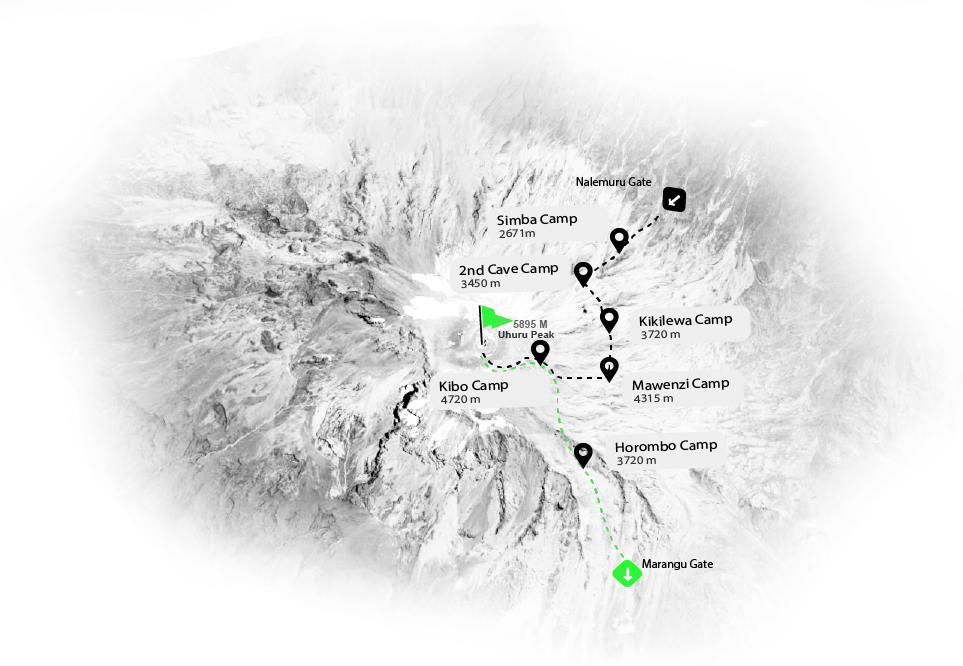
This morning we will drive to the village of Nale Moru for the starting point of the Rongai route. The first stage of the trek is through farmland and pine forests. You may have chance to see the beautiful Colobus monkeys or if you’re lucky enough, elephants or buffalos en route. Our first camp will be the Simba Camp located at the edge of the moorland zone at 2625m.
The morning hike is a steady ascent up to the Second Cave Camp located in the moorland zone with superb views of Kibo and the Eastern ice fields on the crater rim.
A short but steep climb up grassy slopes offers superb views of this wilderness area. The vegetation zone ends shortly before you reach your next camp at Mawenzi Tarn spectacularly situated beneath the towering spires of Mawenzi. Spend the afternoon acclimatizing and exploring the area.
Distance covered: 8km / 5mi
Approx. time taken: 4 – 5 hours
Meals: Breakfast, Lunch & Dinner Included
After breakfast we head west and continue ascending on the east side of Kibo crossing the saddle between Mawenzi and Kibo taking 4 to 5 hours to reach Kibo Hut. The remainder of the day is spent resting in preparation for the final ascent, which begins around midnight. Overnight at Kibo hut.
Distance covered: 8km / 5mi
Approx. time taken: 5 – 6 hours
Meals: Breakfast, Lunch & Dinner Included
You will rise around 23h20, and after some tea and biscuits you shuffle off into the night, and this is where the going really gets tough. The first section of the trail consists of a rocky path to the Hans Meyer Cave (5150m), also a good resting spot.
The path then zigzags up to Gillman’s point (5 681m), which is located on the crater rim. This section is very steep with a lot of stone scree, requiring a great physical and mental effort. This is probably the most demanding section of the entire route. Do the Kili shuffle and move slowly. From Gillmans Point you will normally encounter snow all the way up to Uhuru peak (5895m), the highest point in Africa.
Total exhilaration and satisfaction – you made it
Weather conditions on the summit will determine how long you will be able to spend, taking photographs, before the 3 hour descent back to Kibo hut. After a short rest at Kibo hot, you gather all your gear you left behind for the ascent and head down to Horombo hut (3 hours) for your overnight. The return to Horombo hut will seem surprisingly fast compared to the ascent. The total time spent walking on this day is around 14 hours, so be prepared for a very tough day. Later in the evening you enjoy your last dinner (with soft drinks and beer for sale at the camp office) on the mountain and a well-earned sleep, filled with memories and stirring emotions.
Approx. time taken: 7 to 8 hours to reach Uhuru Peak, 6 to 8 hours to descend to Horombo
Distance: Approxim 12 – 15 hours
Meals: Breakfast, Lunch & Dinner Included
After breakfast you continue your descent (6 hours), passing the Mandara hut, down to the Marangu gate. It is strongly recommended not to pay your porters any tips until you and all your gear have reached the gate safely.
At Marangu gate you sign your name and details in a register. This is also where successful climbers receive their summit certificates. Those climbers who reached Gillman’s Point (5685m) are issued with green certificates and those who reached Uhuru Peak (5895m), receive gold certificates.
You now drive back to Moshi for a long overdue hot shower, dinner descent bed and celebrations!!
Hiking time: 6 hours
Distance: Approximately 29 km
Meals: Breakfast, Lunch & Dinner Included
The day is left free to wind down after the trek before your flight home. Depending on flight times you could go and explore Moshi town and grab some gift shops before heading to the airport.
*Safari, Zanzibar and other add-ons are available if you wish to continue exploring Tanzania
Meals: Breakfast Included



Here are the commonly asked questions by our visitors. If there’s something crucial that we haven’t covered, please Contact Us. Our team is available to assist you at any time.
There are several routes, including Marangu, Machame, Lemosho, Rongai, and more. Each route has its own characteristics, varying in difficulty, scenery, and success rates.
Accommodations vary depending on the route. Typically, climbers stay in tents at designated campsites or huts along the trails. Some routes offer more basic camping experiences, while others have better amenities.
Essential gear includes proper hiking boots, clothing suitable for varied weather conditions, a sleeping bag, trekking poles, a daypack, and other personal items. It’s crucial to have proper gear for both warmth and protection against the elements.
Yes, it’s required to climb Kilimanjaro with a licensed guide and it’s highly recommended to hire porters for carrying equipment. Guides are familiar with the routes, provide safety, and understand altitude-related issues.
The best times are during the dry seasons: January to March and June to October. These periods offer clearer skies and more stable weather conditions, making the climb safer and more enjoyable.
Get your custom itinerary and request a quote.