
Close
We’ve meticulously crafted each day to ensure you enjoy the ultimate experience. From delving into historical landmarks to savoring delectable local flavors, every moment is filled with adventure and thrill. Come along with us as we embark on a journey through some of the most captivating Africa destinations .
You will be picked up at the Kilimanjaro International Airport and transferred to your arranged hotel in Moshi town, you will meet your guide who will brief you on your upcoming trek and do an equipment check to make sure you have all the necessary mountain gear. Gear which is missing can be rented on this day.
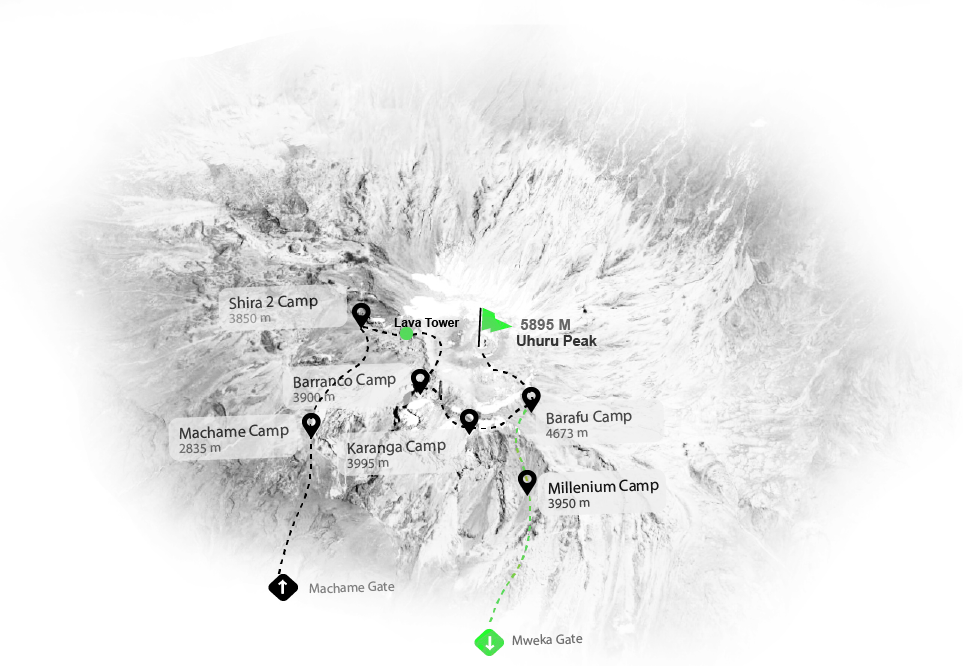
One hour’s drive from Moshi lies the gate to the Machame route, where we complete park formalities, meet our crew of porters and start to climb! The first section of the route climbs steadily and passes through magnificent, dense rainforest. This path is less well-trodden so it can get somewhat overgrown in places and it is often wet and muddy underfoot.
Our route continues on up through the forest until we reach the steep ascent onto the Shira Plateau, where there are rewarding views of the mountain. Looking back, you will be able to see Mt Meru rising high above Arusha town in the distance.
Walking now on high moorland, the landscape changes the entire character of the trek. We traverse the southwest side of Kilimanjaro, passing underneath the Lava Tower and the final section of the Western Breach and finally reach camp The day has been spent at altitude (up to 4600m), but we have followed the mountaineering code of ‘walk high, sleep low’ to aid your body’s acclimatization to altitude.
Our day starts by descending into the Great Barranco, a huge ravine. We then exit steeply, up the Great Barranco Wall, which divides us from the southeastern slopes of Kibo. It’s a climb over rock, not technical, but long and tiring. Passing underneath the Heim and Kersten glaciers, we head towards the Karanga valley, which is our last stop for fresh water before the summit. Scree now forms the terrain as we walk through arid and desolate land towards Barafu camp.
We start off at around midnight, and walk steeply upwards to the summit glaciers. We will be climbing scree for 4 to 5 hours but gain incredible height over a short distance. The views are spectacular. We should be on the crater rim at Stella Point (5739m) as the first rays of the sun hit us. Spectacular ice cliffs within the crater surround us and the views to jagged Mawenzi peak and beyond are breathtaking. Another hour’s walking takes us to the summit, Uhuru Peak (5895m). We begin our descent by returning to Stella Point and then descending on scree slope and track back to Barafu Camp for breakfast, before finally heading down to Mweka Camp for a long well-earned rest.
A gentle trek takes us down through the rainforest to Mweka Gate, where we complete park formalities and receive certificates, which you can hang up with pride! We are then met by our vehicles and return to the hotel in Moshi, where you can treat yourself to a welcome shower then celebrate with cold drinks. Overnight at your arranged Hotel
The day is left free to wind down after the trek before your flight home. Depending on flight times you could go and explore Moshi town and grab some souvenirs before heading to the airport.


Here are the commonly asked questions by our visitors. If there’s something crucial that we haven’t covered, please Contact Us. Our team is available to assist you at any time.
The duration of the climb varies based on the route chosen. Typically, it takes around 5 to 9 days to complete the ascent and descent, depending on the route and the climber’s pace.
There are several routes, including Marangu, Machame, Lemosho, Rongai, and more. Each route has its own characteristics, varying in difficulty, scenery, and success rates.
Accommodations vary depending on the route. Typically, climbers stay in tents at designated campsites or huts along the trails. Some routes offer more basic camping experiences, while others have better amenities.
Essential gear includes proper hiking boots, clothing suitable for varied weather conditions, a sleeping bag, trekking poles, a daypack, and other personal items. It’s crucial to have proper gear for both warmth and protection against the elements.
Yes, it’s required to climb Kilimanjaro with a licensed guide and it’s highly recommended to hire porters for carrying equipment. Guides are familiar with the routes, provide safety, and understand altitude-related issues.
The best times are during the dry seasons: January to March and June to October. These periods offer clearer skies and more stable weather conditions, making the climb safer and more enjoyable.
Get your custom itinerary and request a quote.